When Republics Fall: Are We Witnessing the Last Days of the American Republic?
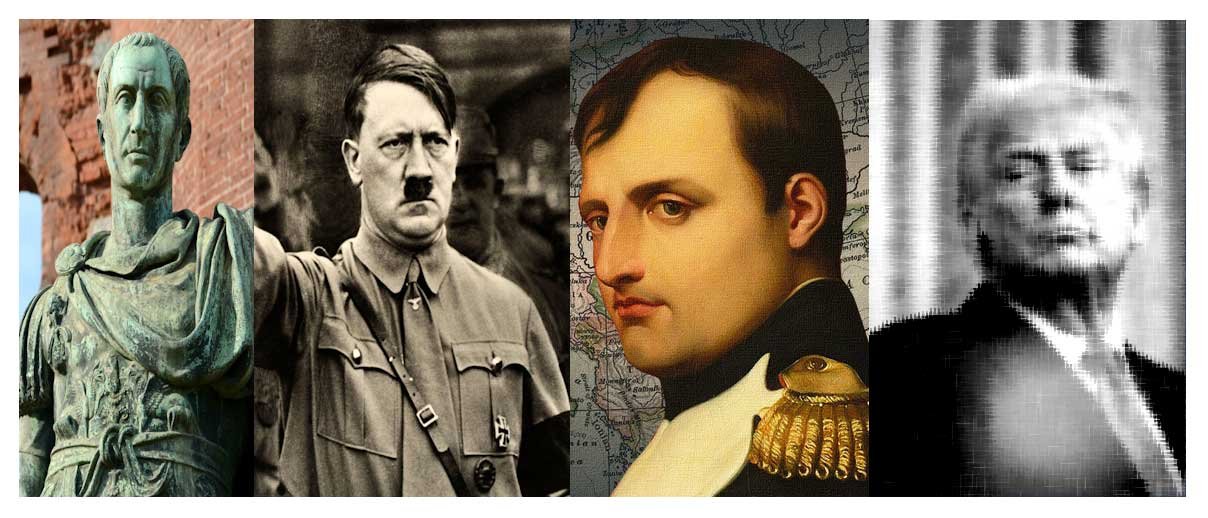
Throughout history, certain leaders rise to prominence not because they inherited thrones or possessed unmatched brilliance — but because they mastered something far more potent: myth-making. A recent lecture compared several of these figures — Robespierre, Napoleon, Julius Caesar, Adolf Hitler, and even Donald Trump — to show how republics can collapse from the inside when charisma overtakes civic virtue.
This blog summarizes that lecture and the larger historical argument behind it.
Robespierre vs. Napoleon: Virtue vs. Myth
The professor begins with a contrast: Maximilien Robespierre and Napoleon Bonaparte — two giants of the French Revolution but absolute opposites in nature.
Robespierre: The Virtuous Revolutionary
Robespierre rose through devotion, not manipulation.
-
He worked tirelessly, lived modestly, took no money, and had no personal life.
-
He believed humans were rational beings — that if you presented a logical argument, people would recognize truth.
-
This faith helped him unify France during the Revolution.
-
But it also caused his downfall: he never imagined his friends would betray him for their own self-interest.
In this telling, Robespierre saved the French Revolution through idealism and integrity.
Napoleon: The Master Politician
Napoleon, the professor argues, succeeded through political maneuvering, not virtue.
-
He found powerful patrons early in life.
-
He did their bidding until he no longer needed them.
-
After the coup that toppled the French Republic, he betrayed those allies and seized power as Emperor.
Napoleon excelled not just at war, but at myth-making — crafting an image of himself as a heroic, almost messianic figure.
And through this myth, he ended the French Republic.
This Pattern Isn’t Unique: Caesar and Hitler
The professor then broadens the pattern:
Julius Caesar
-
Identified and used political patrons.
-
Outmaneuvered them.
-
Built a myth of being an unbeatable general.
-
Ended the Roman Republic.
Adolf Hitler
The professor emphasizes Hitler did not emerge “out of nowhere”:
-
The German military nurtured the Nazi Party as a weapon against communists.
-
Hitler used this backing, then outmaneuvered his own patrons.
-
Through propaganda and myth-making, he presented himself as the savior of Germany.
-
The result: the end of the Weimar Republic.
Across these cases, the same traits appear:
-
Power gained through political maneuvering and betrayal
-
A genius for myth-making
-
A republic collapsing afterward
Is the U.S. At a Similar Inflection Point?
Here the professor becomes provocative.
He suggests that Donald Trump fits the broad pattern:
-
Not a policy expert.
-
Not a skilled business operator by traditional metrics.
-
But extremely skilled at myth creation, media manipulation, and crafting a messianic persona for supporters.
-
He spends much of his time talking to the press, shaping a narrative — not governing in the traditional, administrative sense.
The professor’s argument is not that Trump is Napoleon, Caesar, or Hitler — but that he resembles them in psychology and political strategy.
He then asks:
If republics consistently fall when such myth-making figures rise…
and if the U.S. is approaching a similar moment…
what does that mean for America’s future?
He warns:
If Trump were to dismantle core structures of the American republic in the next decade, then history’s pattern would repeat — and understanding that pattern could help us predict how republics fail.
The Professor’s Core Point
Republics don’t usually die from foreign invasion.
They die when:
-
Citizens lose faith in institutions,
-
A charismatic myth-maker rises,
-
Civic virtue erodes,
-
Political maneuvering replaces moral leadership.
Robespierre represents the fragile idealism needed to create a republic.
Napoleon, Caesar, Hitler — and potentially Trump — represent the mythic strongman who ends it.
If the pattern holds, the lecture concludes, we may be living through another historical turning point.