Arthur Schopenhauer on Intelligence, Wisdom, and the Tragedy of Unexamined Belief
Arthur Schopenhauer is often quoted as a misanthrope who despised humanity and believed most people were stupid. That reading is tempting—but incomplete. Schopenhauer was not primarily interested in insulting people. He was interested in understanding why human beings so rarely arrive at truth, and why wisdom is far scarcer than information, confidence, or belief.
His conclusions were unsettling, not because they were cruel, but because they were diagnostic. Schopenhauer treated human cognition the way a physician treats symptoms: without sentimentality, but also without moral outrage.
At the heart of his philosophy lies a sober distinction between intelligence, wisdom, and belief, and an even sharper distinction between thinking and merely assenting.
Intelligence Is Not Universal—and That Matters
Schopenhauer rejected the comforting assumption that all people are equally capable of rational thought if given enough education or explanation. In The World as Will and Representation and later essays, he repeatedly emphasized that intellectual capacity varies significantly, and that this variation has real consequences for discourse, politics, and culture.
He observed that many people are capable of:
-
Learning rules
-
Memorizing doctrines
-
Repeating accepted opinions
But far fewer are capable of:
-
Abstract reasoning
-
Sustained self-criticism
-
Independent judgment
This is why he famously wrote that most people are not capable of thinking, but only of believing, and are therefore more responsive to authority than to reason.
This was not meant as an insult. It was an observation about how cognition actually functions in most people. Belief is easier than thought. Deference is easier than investigation. Emotional certainty is easier than intellectual doubt.
Belief by Indoctrination vs. Belief by Inquiry
One of Schopenhauer’s sharpest insights concerns the origin of belief.
He distinguished between beliefs that arise from:
-
Personal inquiry
-
Direct observation
-
Logical reflection
and beliefs that arise from:
-
Cultural inheritance
-
Social pressure
-
Authority and repetition
Most beliefs, he argued, belong to the second category.
People tend to adopt the worldview of their environment—family, religion, nation, class—and then defend it as if it were the product of reason. But in reality, the reasoning comes after the belief, not before it. Argument is often used not to discover truth, but to protect identity.
This explains why evidence rarely changes minds. If a belief was never arrived at through inquiry, it cannot be undone by inquiry either.
Schopenhauer was blunt about this: you cannot reason someone out of a position they did not reason themselves into.
Emotion Precedes Reason More Often Than We Admit
Long before modern psychology, Schopenhauer recognized that emotion drives cognition far more than logic does.
He held that human beings are fundamentally governed by what he called the Will—a blind, striving force beneath conscious thought. Reason, in most cases, serves the Will rather than governing it. People feel first, then justify.
This is why debates so often fail. When emotion is primary, logic becomes decorative. Facts are filtered through desire, fear, pride, and tribal loyalty.
For Schopenhauer, this was not a flaw of modern society. It was a structural feature of human nature.
Why Confidence So Often Accompanies Ignorance
Schopenhauer noted a paradox that modern psychology later formalized: those with the least understanding often display the greatest certainty.
Genuine thinking requires:
-
Awareness of complexity
-
Recognition of uncertainty
-
The ability to imagine being wrong
Those capacities themselves require intelligence. Without them, doubt never arises. The result is absolute confidence built on shallow foundations.
Thus, ignorance is not humble. It is often loud, assertive, and resistant to correction—not out of malice, but incapacity.
Wisdom Is Not Intelligence
Importantly, Schopenhauer did not equate intelligence with wisdom.
Intelligence is cognitive capacity.
Wisdom is clarity about reality and restraint toward illusion.
A highly intelligent person can still be foolish if they are enslaved to ego, desire, or social approval. Wisdom, for Schopenhauer, involved:
-
Acceptance of unpleasant truths
-
Resistance to comforting falsehoods
-
Detachment from collective delusions
This is why wisdom is even rarer than intelligence.
Truth Is Not Popular—and Never Has Been
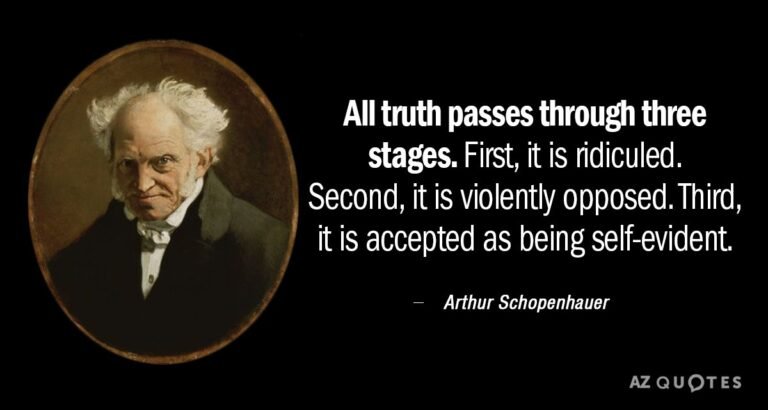
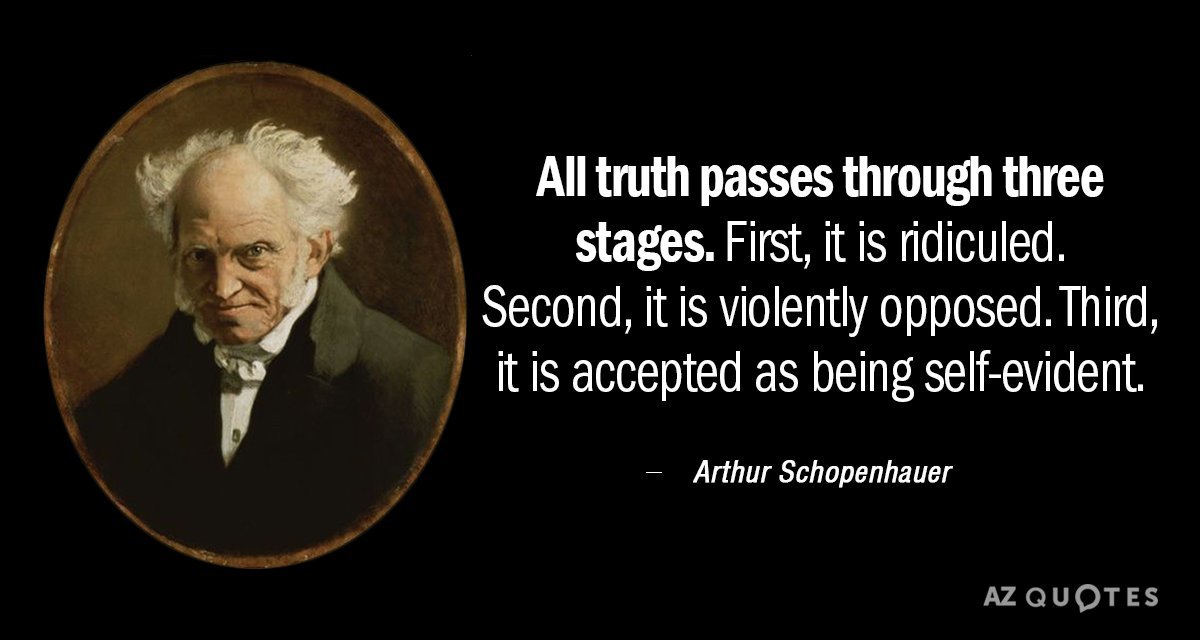
Schopenhauer famously observed that truth often passes through stages: ridicule, resistance, and eventual acceptance. But he did not romanticize this process. Most truths, he believed, never reach the final stage at all.
Why?
Because truth demands psychological cost:
-
Admitting error
-
Revising identity
-
Abandoning certainty
Most people prefer coherence over accuracy and comfort over correctness.
As a result, societies function largely on shared illusions—necessary, stabilizing illusions—but illusions nonetheless.
Why the Intelligent Often Feel Isolated
Schopenhauer acknowledged that intellectual clarity often leads to solitude. Not because the intelligent despise others, but because mutual understanding requires compatible depth.
Conversation, for him, was only meaningful when minds could meet at the same level of abstraction. Otherwise, interaction required constant simplification, distortion, or self-censorship.
His solution was not bitterness, but selectivity:
-
Speak plainly, but not indiscriminately
-
Share depth with those capable of receiving it
-
Accept that not everyone can—or should—be reached
Acceptance, Not Contempt
Contrary to modern misreadings, Schopenhauer did not advocate arrogance or cruelty. His philosophy was ultimately one of acceptance.
You cannot change:
-
The distribution of intelligence
-
The emotional foundations of belief
-
The limits of another person’s cognition
But you can change your expectations.
For Schopenhauer, peace came not from reforming humanity, but from seeing it clearly and acting accordingly.
Final Thought
Schopenhauer’s philosophy is uncomfortable because it removes flattering illusions—about human rationality, openness, and equality of thought. But it is not nihilistic. It is clarifying.
It teaches that:
-
Thought is rare
-
Wisdom is rarer
-
Truth is costly
-
Belief is often inherited, not earned
And that clarity, once achieved, should be guarded, not squandered.
Not everyone can think deeply.
Not everyone wants truth.
And that, Schopenhauer would say, is not a moral failure.
It is simply reality.