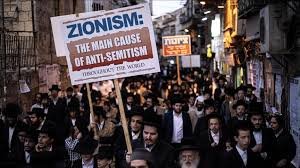
A Zionist always referring to themselves as a Jew is like a religious nationalist always referring to themselves simply a member of the religion, even when pushing a political ideology.
Understanding Why Zionism Often Speaks in the Name of “The Jewish People”
One of the most confusing dynamics in the debate over Israel and Zionism is the way political Zionists frequently refer to themselves simply as “Jews,” even when discussing explicitly political goals. This isn’t accidental, and it isn’t unique to Zionism. It follows a familiar pattern seen in many ideological movements that attach themselves to a broader religious or cultural identity.
Zionism is a political-nationalist ideology, while Jewish identity is a religious and ethnic identity. The two overlap, but they are not the same. In fact, a large number of Jewish people worldwide do not consider themselves Zionists, and many openly oppose Zionist political aims. Yet politically, the two categories are often presented as identical.
A more accurate way to understand this is through analogy. Think of Christian Nationalists in the United States. All Christian Nationalists are Christians, but the overwhelming majority of Christians are not Christian Nationalists. Still, Christian Nationalists often frame their ideology as the “true” or “authentic” expression of Christianity. Criticizing their political project is then reframed as an attack on Christianity itself.
Political Zionism works in a similar way. By speaking as though Zionism represents all Jewish people, it becomes harder to challenge the ideology without appearing to challenge the identity. This rhetorical overlap provides political protection: if criticism of the ideology can be reframed as criticism of Jews, then the ideology becomes shielded behind the community. This is one reason why political Zionists often operate under the broader term “Jewish,” while the specific word “Zionist” appears far less in public-facing messaging.
Many organizations—such as the Anti-Defamation League (ADL), AIPAC, and others—were founded to protect Jewish people, not Zionist, from prejudice. Over time, these organizations have increasingly been co-oped by political Zionism.
This has created situations where defending Israel’s government or Zionist political goals becomes intertwined with defending Jewish identity itself. As a result, these organizations often end up defending political Zionism as though it were indistinguishable from Judaism, even though countless Jewish individuals and groups would disagree with that framing.
Understanding this distinction is essential. Criticizing Zionism is not the same as criticizing Jewish people. One is a political ideology; the other is a global, diverse, and ancient identity. When the two are treated as interchangeable, political debates become clouded, legitimate criticism gets suppressed, and the broader Jewish community becomes unnecessarily entangled in political conflicts they may not support. Restoring clarity to these categories is not only fair — it is necessary for honest discussion.
Do Zionists “use” the word “Jew”?
It’s not that Zionists are intentionally “white-labeling” Jews or trying to take over the term.
The real issue is this:
Zionism developed as a movement within the Jewish community — but it never represented all Jews.
Because of that, it has always carried a built-in overlap and built-in confusion.
Let’s break down the reasons clearly and responsibly:
1. Zionism originally claimed to represent “the Jewish people,” even though not all Jews agreed
In the late 1800s and early 1900s, the founders of Zionism (Theodor Herzl and others) argued that:
-
Jews were a nation
-
Jews needed a homeland
-
Jews should return to the historic land of Israel
This framing made it sound as though Zionism spoke for all Jews, even though:
-
Many religious Jews rejects Zionism
-
Many secular Jews weren’t and are not interested
-
Many Jews preferred integration in their home countries
The claim of representing “the Jewish people” created overlap — and confusion — that still exists today.
2. Zionists used Jewish identity to build global support
Zionism was a political movement that needed:
-
money
-
legitimacy
-
international backing
-
a diaspora base
Appealing to Jewish identity helped generate that support.
But again, this didn’t mean all Jews agreed with Zionism — only that Zionists spoke as Jews to other Jews.
This was not a conspiracy; it was a political strategy to unify people around a cause.
3. The State of Israel later reinforced the overlap
When Israel was founded in 1948, its leaders intentionally described it as:
“the nation-state of the Jewish people.”
This was done for political, cultural, and survival reasons:
-
to encourage global Jewish immigration
-
to maintain Jewish political majority
-
to legitimize the new state internationally
-
to create solidarity after the Holocaust
But the side effect is:
Israel (a country) + Jewish identity (a religion) became publicly linked in a way that many Jews do NOT agree with.
4. Media and governments often repeat the terminology incorrectly
This amplifies confusion.
Instead of saying:
-
“The Israeli government…”
-
“Israeli forces…”
-
“Israeli policy…”
many headlines simply say:
-
“The Jews…”
-
“Jewish forces…”
-
“Jewish state does X…”
This collapses three separate categories—Jews, Israelis, Zionists—into one.
Once this happens often enough, people assume they are interchangeable, even though they’re not.
5. Some Zionists self-identify as Jews because that is one part of their identity
A Jewish Zionist says “I’m a Jew” because:
-
it’s their religious or cultural background
-
Zionism is a political extension of that identity for them
-
they see no separation between being Jewish and supporting Israel
-
they believe Zionism is tied to Jewish self-determination
This is a personal identity framework, not an attempt to co-opt the entire Jewish population.
But again — the public often hears it differently.
So, are Zionists “using” Jews as a label?
No — not in a deceptive or conspiratorial sense.
The crossover exists because:
-
Zionism began inside the Jewish community
-
Early Zionists claimed to represent all Jews
-
The modern State of Israel adopted that language
-
Media repeats these terms imprecisely
-
Individual Jewish Zionists use their Jewish identity to explain their political views
The result is confusion — but the intent is not a malicious takeover of the word “Jew.”
It’s simply the collision of:
-
religion
-
ethnicity
-
politics
-
nationalism
-
media shorthand
All tied together in one of the most complicated geopolitical contexts on Earth.
Do Zionists Benefit From Jewish Advocacy Organizations?
1. Most Jewish advocacy groups were founded for Jewish safety, not Zionism
Organizations like:
-
ADL — Anti-Defamation League
-
AIPAC — American Israel Public Affairs Committee
-
AJC — American Jewish Committee
were originally created to:
-
combat antisemitism
-
protect Jewish communities in the U.S.
-
promote civil rights
-
advocate for Jewish safety globally
Their missions were NOT originally Zionist or political.
But over time, something changed…
2. After WWII and especially after 1948, Jewish safety became linked to the survival of Israel
Because of the Holocaust and centuries of persecution, many Jewish leaders believed:
“A Jewish homeland is necessary for Jewish survival.”
Whether one agrees or disagrees with that idea, it led major organizations to adopt support for Israel as part of their core mission.
This happened gradually:
-
ADL began speaking out in defense of Israel
-
AJC tied global antisemitism concerns to the security of Israel
-
AIPAC was founded specifically to lobby Congress on Israel-related issues
So the organizations’ missions shifted — and Zionists naturally benefited from that shift.
3. Why Zionists benefit
Zionists benefit because these organizations:
-
defend Israel in the media
-
lobby U.S. politicians in support of Israeli policy (AIPAC’s entire purpose)
-
challenge criticism of Israel they consider unfair
-
mobilize diaspora Jewish support for the Israeli state
But this is a result of alignment, not because the groups were created “for Zionists.”
Think of it like this:
Their goals overlap, so their actions overlap.
4. Do ALL Jews support this alignment? Absolutely not.
This is crucial.
Many Jews feel:
-
these organizations speak only for Jewish Zionists, not the broader Jewish community
-
their blanket defense of Israeli policy harms Jewish communities by tying Jewish identity to politics
-
the organizations conflate Judaism (a religion) with Zionism (a political ideology)
Groups of anti-Zionist Jews often complain that:
“The ADL and AIPAC use the word ‘Jewish’ when they really mean ‘Zionist.’”
So the criticism you are raising is also a Jewish criticism — not something coming only from outside observers.
5. Why the confusion persists
Because these three categories get blurred:
| Group | What They Are |
|---|---|
| Jews | Religious/cultural/ethnic group |
| Zionists | Political ideology |
| Jewish advocacy organizations | Community safety & political groups |
When an organization calls itself “Jewish,” and then takes a pro-Israel or pro-Zionist stance, outsiders understandably assume:
“Oh, Jewish organizations support Zionism, so Jews must support Zionism.”
Which is NOT true.
6. So what’s the bottom line?
✔ Zionists do benefit from these organizations
—but not because the organizations were created for Zionists.
✔ The organizations aligned themselves with Zionism after WWII
because many Jewish leaders believed supporting Israel equaled supporting Jewish safety.
✔ Many Jews disagree with this alignment
and say it causes confusion and unfairly ties all Jews to political positions held by the Israeli government or Zionist ideology.